



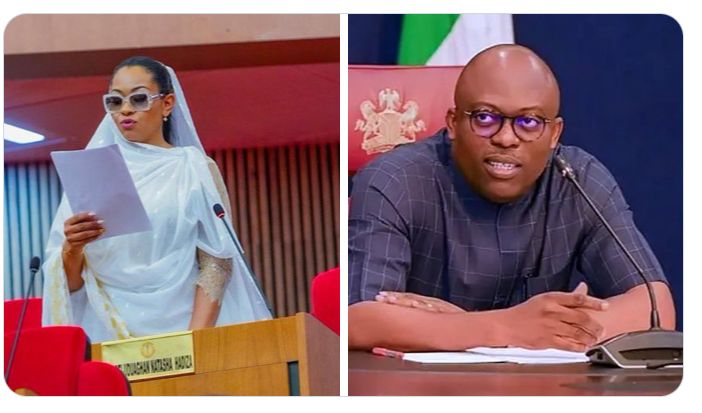
Akpoti-Uduaghan and Fubara :A Match to Remember in Nigeria’s Democracy;
Political Loyalty more important than democratic principle in Nigeria?
By Comfort Chukwukelue
Nigeria’s democracy continues to face serious challenges, with political controversies exposing weaknesses in governance, institutional integrity, and public trust. Two recent incidents—the suspension of Senator representing Kogi Central, Natasha Akpoti-Uduaghan after her allegations against Senate President, Godswill Akpabio and the ongoing power struggle between Rivers State Governor Siminalayi Fubara and former Governor Nyesom Wike—highlight the fragile state of Nigeria’s democratic system. These controversies raise important concerns about gender discrimination, political interference, and the erosion of democratic values.
We recall that on February 28, 2025, Senator Natasha Akpoti-Uduaghan accused Senate President Godswill Akpabio of sexual harassment, alleging that the incident occurred on December 8, 2023. The situation escalated on February 20, 2025, when she confronted Akpabio in the Senate chamber after discovering her nameplate had been removed from her usual seat. Subsequently, on March 6, 2025, the Senate suspended Akpoti-Uduaghan for six months, citing “persistent acts of misconduct,” including refusing to sit in her assigned seat, speaking without recognition, and making abusive remarks against Senate leadership. The Senate’s Ethics Committee dismissed her sexual harassment allegations on procedural grounds, stating that her petition was “dead on arrival” because she had signed it herself. Akpabio has denied any wrongdoing.
One of the most troubling effects of these events is the weakening of democratic institutions. The Senate’s swift suspension of Akpoti-Uduaghan, rather than conducting a thorough and independent investigation into her claims, suggests that political influence outweighs justice in Nigeria’s legislative system. A democracy thrives when its institutions function independently and fairly, but when those in power manipulate the system to protect their interests, democracy suffers.
In Rivers State, the ongoing crisis between Governor Fubara and his predecessor, Wike, further illustrates this problem. Despite leaving office, Wike’s continued influence over the state’s politics undermines the democratic process, where elected officials should have full autonomy to govern without external interference. When political institutions fail to uphold democratic principles, governance becomes unstable, and citizens lose faith in the system.
In a move widely criticized as unlawful, Governor Siminalayi Fubara’s recent actions have inadvertently laid bare his deep-seated conflict with former Governor Nyesom Wike. During a public address, Fubara bypassed established legislative protocols to implement controversial policy changes—actions that many interpret as a direct challenge to Wike’s lingering influence in Rivers State politics. Critics argue that this defiance not only undermines legal norms but also serves as an implicit admission of the bitter power struggle between the two political figures, revealing how personal conflicts continue to disrupt democratic governance.
Public trust in governance is another casualty of these controversies. For democracy to succeed, citizens must believe in the fairness and integrity of their leaders and institutions. However, the handling of Akpoti-Uduaghan’s case and the power struggle in Rivers State have deepened public skepticism. Many Nigerians see these events as further proof that those in power prioritize political survival over justice and good governance. The suspension of a female senator immediately after making serious allegations against a high-ranking official raises concern about political suppression and selective justice. Similarly, the Rivers State crisis, which has been marked by violent confrontations and legal battles, suggests that elections alone do not guarantee stable leadership, rather it is also essential that elected officials enjoy autonomy to deliver on the mandate bestowed on them by citizens. This growing distrust discourages civic participation, increases voter apathy, and creates an environment where people feel powerless to influence government decisions. A democracy that fails to earn the trust of its citizens risks becoming a mere façade, where elections are held but true representation is absent.
Another critical issue highlighted by these controversies is gender inequality in Nigerian politics. Women are already severely underrepresented in governance, holding less than 10% of elective positions. The suspension of Akpoti-Uduaghan, coming after she made allegations of sexual harassment, sends a worrying message about how female politicians are treated when they challenge authority. Many women’s rights groups have condemned the Senate’s actions, arguing that it discourages women from participating in politics. True democracy requires inclusivity, where both men and women can engage in leadership without fear of discrimination or suppression. If women continue to face such barriers, Nigeria’s democracy will remain incomplete, as it fails to reflect the voices and experiences of half its population.
Furthermore, the political crisis in Rivers State has reinforced the dangers of power struggles within Nigeria’s democracy. Governor Fubara’s administration has been repeatedly undermined by forces loyal to Wike, raising concerns about the independence of elected officials. When a former leader continues to exert control over their successor, it sets a dangerous precedent, suggesting that political power is not truly transferred through elections but remains in the hands of a few individuals. This weakens the democratic process and encourages a culture where political loyalty is valued more than governance. As is often said ‘when two elephants fight it is the grass that suffers’; such instability can lead to violence, which inevitably grinds government to a halt, thereby ensuring that citizens are unable to enjoy the dividends of true democratic governance, as seen in Rivers State, where protests and clashes have erupted and the climate has become obstructive to positive activities, economic and social alike. Furthermore, political violence not only threatens lives but also discourages qualified individuals from seeking leadership positions, further weakening Nigeria’s democratic institutions.
In conclusion, the controversies surrounding Natasha Akpoti-Uduaghan and Governor Fubara highlight serious flaws in Nigeria’s democracy. Weak institutions, political interference, gender discrimination, and the erosion of public trust are all signs that democracy in the country is under threat. To build a stronger democratic system, Nigeria must ensure that political institutions function independently, promote fairness and inclusivity, and protect the rights of all citizens, regardless of gender or political affiliation. Without these reforms, democracy in Nigeria will continue to struggle, leaving the country vulnerable to instability, corruption, and poor governance. Young people, women, Rivers State citizens, Nigerians and international observers alike, are keenly observing these events unfold, and will use the results of this observation as indicators on the hope or lack thereof that Nigeria’s adherence to the rule of law and democratic principles might provide.

