



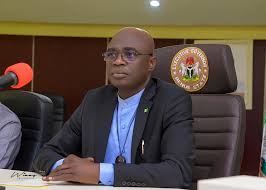
ALIA AT 60: Balancing the Cassock, the Gavel, and the Ghost of Benue’s Past
On May 15, 2026, the Executive Governor of Benue State, Reverend Father Hyacinth Iormem Alia, marks a significant personal milestone as he hits the diamond age of 60. Concurrently, the state is gearing up to evaluate his three years in the saddle as the chief executive of Nigeria’s acclaimed ‘Food Basket of the Nation.’
For a state historically gridlocked by systemic administrative leaks, perennial unpaid civil service emoluments, and a deeply volatile internal security architecture, the ascension of a Catholic priest to the highest political office in May 2023 was widely viewed as a radical sociopolitical experiment.
Three years into his four-year mandate, an objective assessment of the Alia administration reveals a landscape characterized by aggressive fiscal discipline and unprecedented infrastructural footprints, balanced against the stubborn, complex challenges of regional insecurity.
Prior to June 2023, the Benue State civil service was defined by morale-dampening backlogs of unpaid salaries and pensions. Upon taking the oath of office, Governor Alia’s immediate policy directive targeted the regularisation of the state’s payroll structure.
By prioritizing worker welfare, the administration established a predictable 25th-day monthly salary payment cycle. This consistent injection of liquidity into the local economy has stabilized the state’s dominant micro-economic driver: public service consumption. Furthermore, the systematic automation of local government and state payrolls successfully weeded out thousands of “ghost workers”—an administrative leakage that had bled the state treasury dry for over a decade.
In terms of physical development, the Alia administration has transformed the face of Makurdi, the state capital, alongside key commercial hubs like Gboko and Otukpo. Over the last 36 months, the government has executed the construction of over 50 strategic intra-city and rural arterial roads.
The rationale behind this infrastructural drive extends beyond urban aesthetics; it targets agricultural logistics. By connecting agrarian rural communities to urban market nodes, the administration has significantly reduced post-harvest losses, empowering local farmers who form the bedrock of the Benue electorate.
Despite notable economic and infrastructural gains, the administration’s most significant test remains the protracted security crisis plaguing the state. Benue has long been an epicenter of deadly communal clashes, farmer-herder conflicts, and opportunistic banditry.
While Governor Alia has consistently denied claims of external agendas or targeted genocide in the state, insisting on a more nuanced approach to handling localized violence, the security architecture remains fragile. Just recently, armed gangs attacked a passenger vehicle along the Otukpo-Makurdi highway, abducting university students bound for examinations—an incident the governor vehemently condemned.
The administration’s strategy has gradually tilted away from purely retributive and reactive security deployments toward community-led mediation and structured engagement. However, deep-seated displacements and sporadic attacks on rural communities continue to demand a more robust, long-term security framework.
At 60 years of age and three years into his governance, Rev. Fr. Hyacinth Alia remains a unique, polarizing, yet undeniably transformative figure in Benue’s political history. He has successfully demystified the notion that state funds are structurally insufficient to pay basic workers’ salaries or construct durable public utilities.
However, as the administration heads into its final year before the next electoral cycle, the ultimate validation of his legacy will depend on two critical things:
The long-term sustainability of his aggressive fiscal models.
His ability to return displaced rural populations safely back to their ancestral farms.
For the priest-governor, the honeymoon period is formally over; the remaining months of his first term will determine whether his administrative blueprint can truly institutionalize lasting peace and prosperity in Benue State.

