



Auto Policy: Stakeholders task NASS on legal framework to drive local production
By Comfort Chukwukelue
ABUJA — A renewed push to give Nigeria’s automotive development framework full legal backing gained momentum in Abuja on Monday, as stakeholders urged the National Assembly to fast-track pending automotive bills to unlock the sector’s economic potential.
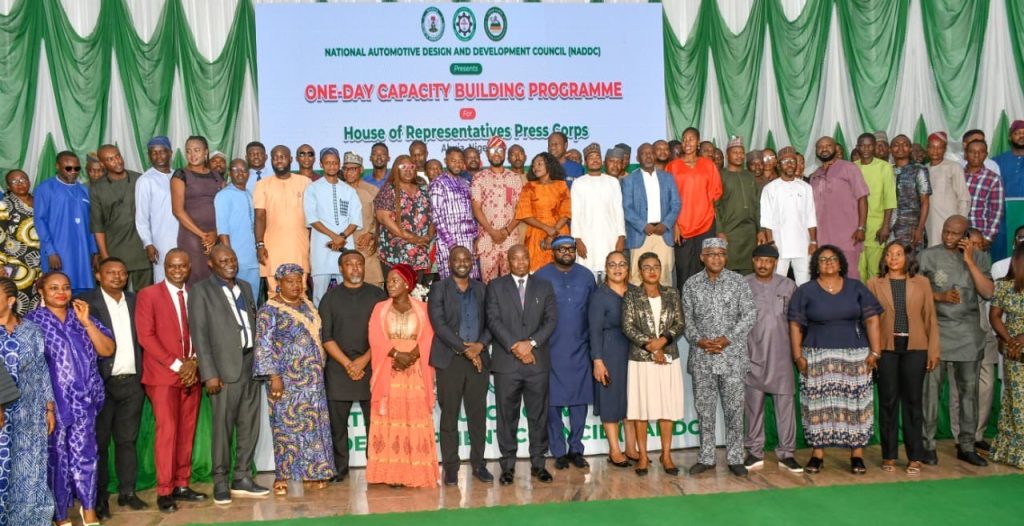
The call was made during a one-day capacity training for members of the House of Representatives Press Corps, organised by the National Automotive Design and Development Council (NADDC) in collaboration with the House Committee on Media and Public Affairs.
The session focused on strengthening sectoral policy communication and legislative reporting on the nation’s automotive industry.
Speaking at the event, Director-General of the NADDC, Mr. Joseph Osanipin, maintained that policy direction alone is insufficient to drive long-term industrial growth.
“The Nigeria Automotive Industry Development Plan provides direction, but investors need assurance that policy incentives will endure beyond administrative cycles,” he said.
Osanipin warned that Nigeria’s continued dependence on imported vehicles and spare parts, estimated at trillions of naira annually, is economically unsustainable. He argued that codifying the automotive policy into law would provide the legal certainty required to stabilise the regulatory environment, deepen local production, and attract large-scale investment in component manufacturing.
According to him, the automotive sector is capital-intensive, requiring billions of dollars to establish full manufacturing plants.
“Manufacturers considering serious investment need guarantees that fiscal incentives and regulatory frameworks will remain stable over time,” he added, noting that the Council plans further engagements with lawmakers to solidify the legal foundation of the plan.
Highlighting the nation’s mobility gap, Professor Oscar Odiboh of Delta State University, Abraka, cited World Bank data indicating that about 104 million Nigerians — representing 52 per cent of the population — lack adequate access to vehicular movement.
“This population includes the urban poor, rural dwellers, and underpaid workers,” Odiboh said. He added that nearly five million businesses in Nigeria depend on transportation, with daily mobility needs valued at approximately N122.6 billion.
Odiboh identified high vehicle costs and inconsistent policies as major constraints, emphasising that the success of the “Made-in-Nigeria” initiative depends on genuine local manufacturing rather than mere assembly.
On his part, the Managing Director of OMAA, an indigenous automotive firm, Mr. Chinedu Oguegbu, provided a grim continental comparison. He noted that while Morocco produces about 700,000 vehicles annually and earns $17 billion from exports, Nigeria produces roughly 10,000 vehicles yearly while spending an estimated $4.5 billion on imports.
He urged the Federal Government to leverage Compressed Natural Gas (CNG) technology as a cost-effective and environmentally friendly alternative fuel option.
Also speaking, Chairman, House Committee on Media and Public Affairs, Akin Rotimi, underscored the importance of informed legislative reporting, stating that “legislative work is only complete when policies are clearly understood by citizens.”
In their separate remarks, Chairman of the Nigeria Union of Journalists (NUJ), FCT Council, Grace Ike, and Chairman of the House of Representatives Press Corps, Gboyega Onadiran, called for policy-focused journalism to promote accountability and reduce the pressure of vehicle importation on the nation’s foreign exchange reserves.

