



2025 Budget: CSO Blames Finance Ministers, Accountant-General for Economic and Health Sector Collapse
Editor
A pro-democracy and civil society organisation, the National Vanguard for Accountable and Transparent Democracy (NVATD), has blamed the Minister of Finance, Mr. Wale Edun, the Minister of State for Finance, Dr. Doris Uzoka-Anite, and the Accountant-General of the Federation (AGoF), Mr. Shamsedeen Babatunde Ogunjimi, for what it described as the near collapse of Nigeria’s economy and key social sectors, particularly health.
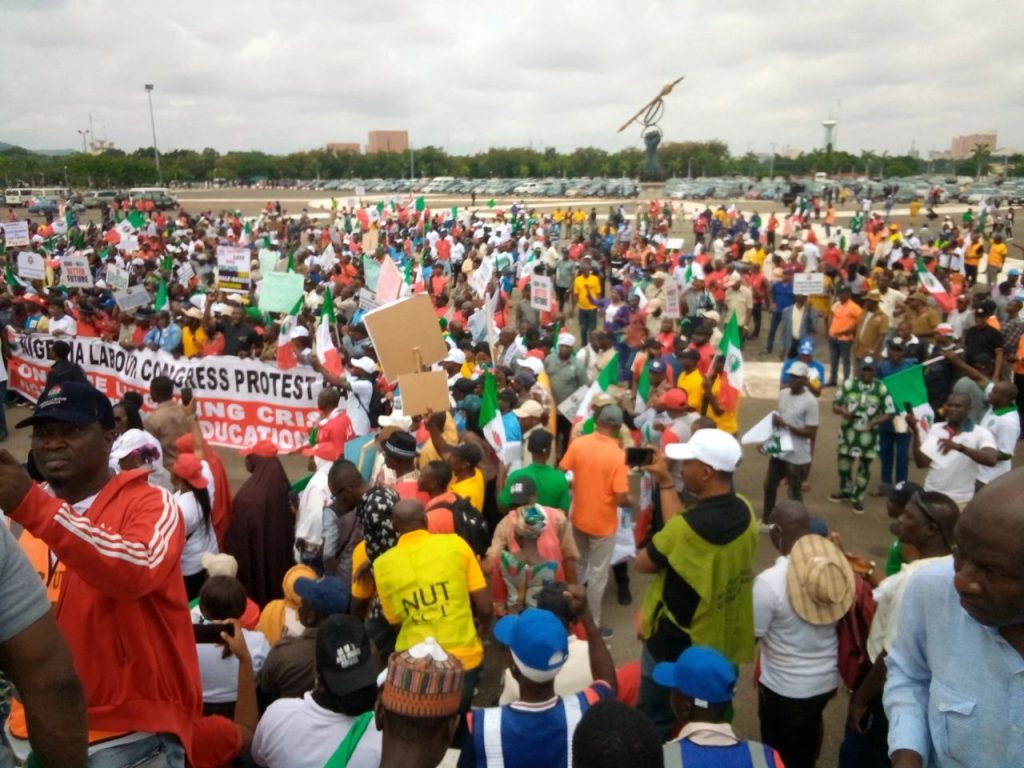
Speaking on Tuesday during a protest at the National Assembly in Abuja, NVATD Secretary-General, Dr. Harry Linus, accused the finance leadership of deliberately undermining the implementation of the Federal Government’s budgets, thereby frustrating the reform agenda of President Bola Ahmed Tinubu.
According to Dr. Linus, the refusal of the relevant public officers to adequately fund capital projects approved under the 2024 Appropriation Act has stalled development across virtually all sectors, resulting in the widespread non-performance of the 2025 budget.
He said public confidence in the 2026 Appropriation Bill, currently before the National Assembly, would have been significantly higher if the implementation of the 2024 and 2025 budgets had demonstrated fiscal discipline and accountability.
Dr. Linus was reacting to the public lamentation by the Minister of Health and Social Welfare, Prof. Muhammad Ali Pate, who on Monday disclosed the poor implementation of the health sector budget.
“It is shameful that this public outcry is coming from a serving minister within the same administration. The ripple effects of this failure have cut across nearly all sectors of the economy,” Linus said.
He argued that had the Ministry of Finance and the Office of the Accountant-General complied with directives to settle outstanding payments to local contractors—estimated at over ₦4 trillion for projects executed under the 2024 budget—the 2025 budget would have recorded substantial performance, thereby strengthening public trust in the 2026 proposals.
The group further urged the National Assembly to fast-track the passage and fine-tuning of the Electoral Act, while also insisting that lawmakers should withhold budgetary approvals for agencies that failed to perform in the 2024 and 2025 fiscal years, except in critical sectors such as health, education, and security.
Dr. Linus added:
“We watched Prof. Ali Pate defend the 2026 budget before the National Assembly yesterday. He was visibly distressed while explaining that only ₦36 million was released out of over ₦200 billion appropriated for public health in the 2025 budget. One can only imagine the frustration of a medical professional sworn to protect lives but constrained by the actions of his colleagues.”
He explained that many contractors executed projects captured in the 2024 budget—often through bank loans—and that several of these projects had already been commissioned by the Federal Government, yet payments remain outstanding.
“As long as the 2024 budget is not properly serviced, new contracts under the 2025 appropriation cannot move forward. That is why virtually no sector performed in 2025. The responsibility squarely lies with the Minister of Finance, the Minister of State, and the Accountant-General of the Federation,” he said.
According to the group, the funding crisis has contributed to recurring industrial actions and service disruptions across the country, including threats of strikes by university lecturers and shortages of essential medical supplies in hospitals.
It will be recalled that on Monday, Prof. Ali Pate, while appearing before the House of Representatives Committee on Healthcare Services, revealed that only ₦36 million, largely for overheads, had been released to his ministry out of the ₦218 billion appropriated in the 2025 budget.
The Minister attributed the poor performance of the capital component of the budget to cash-flow constraints and systemic bottlenecks in the Federal Government’s budget execution process, particularly the bottom-up cash planning system managed by the Office of the Accountant-General of the Federation.
He noted that while the ministry’s personnel costs were fully released and utilised, capital funding suffered severe shortfalls, despite the health sector operating within established national frameworks such as Vision 20:2020, the Medium-Term National Development Plan (2021–2025), and the National Strategic Health Development Plan II.

